
Business Records Essentials
Learn to organise business records, check a supplier invoice against an order and delivery note, and prepare a month-end handoff.
Business Records Essentials is a beginner course for founders, operations staff and anyone who keeps records for a small team. In about 35 minutes, you will organise one supplier order, check an invoice against what arrived and prepare a month-end handoff another person can use. You need a spreadsheet or a notes app and a place to save the practice records.
Table of Contents
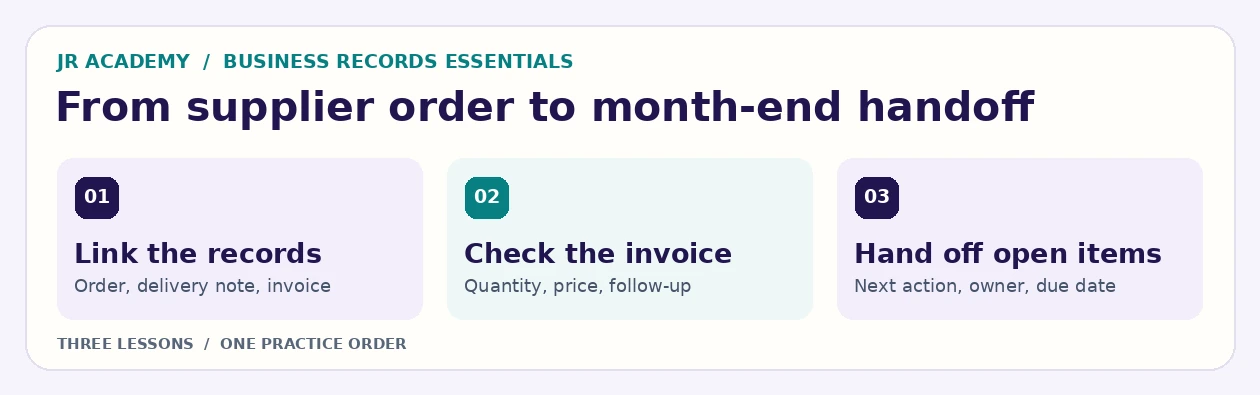
Follow one fictional purchase from the order to the delivery note and supplier invoice. Before you start, make a blank register with columns for the document reference, file link, status and next action. Keep it open as you work so you can record each decision against the right document. The same example runs through the course, so you can see how a small mismatch affects the business records the team keeps, what it asks the supplier and what it carries into the next month.
What you will learn in Business Records Essentials
1. Organise the records for one order
Start with a register that links the purchase order, delivery note and invoice. Use a common order reference so the three documents can be found together, and keep each document’s own number. Practise naming a file and adding its date, status and link. These fields make business records traceable after the order is complete. Your register should let a colleague find the original file and see what has happened without searching through messages.
2. Check an invoice against the order and delivery
Compare the quantities ordered, received and invoiced line by line. Check the unit price against the order and calculate the value of any difference. Then draft a question the supplier can answer. A precise follow-up names the item, gives the relevant document references and asks whether a missing delivery or a replacement invoice will resolve the difference.
3. Prepare a month-end handoff
Separate resolved records from items that still need attention. For each open item, write the next action, name the person responsible and set a due date. Link the supporting documents and add enough context for the next reviewer to pick up the work. You will practise turning a vague note about a supplier query into a handoff with an owner and a clear next step.
How the course works
Business Records Essentials is taught in English. Work through the three lessons in order, try the exercises and compare your work with the lesson self-checks. The knowledge check has four questions. To complete the course, finish all three lessons and score at least three out of four on the quiz. You have up to three attempts.
Allow about 35 minutes for the lessons, exercises and quiz. You can pause between lessons and return to your learning dashboard. Keep a copy of your register and handoff from the exercise. You can reuse the same headings to practise with a second sample order and check whether another person can follow your notes.
Who this course is for
The course suits small teams that keep business records in spreadsheets, shared folders or email. It is also useful if you are taking over a filing process from a colleague and need to understand how purchase documents fit together. No accounting software or prior bookkeeping experience is required.
For team training, have two people work through the same example independently. Compare how each person named the documents, identified the difference and assigned the follow-up. Agree on the minimum fields your team would need to understand the same issue a week later. Use fictional files for the exercise if your real supplier records contain confidential information.
Try a short business records exercise
Take a few minutes to try a different order from the one used in the lessons. A team orders ten file boxes at USD 12.50 each. The delivery note lists eight boxes, and the invoice charges for ten. Use these sample business records to decide what the next person needs to know. Write your first response before you compare it with the examples below.
Log the business records for the order
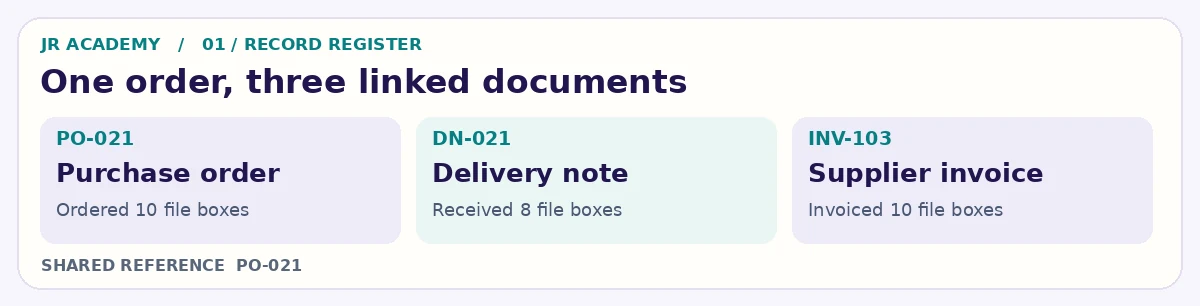
Use PO-021 as the shared reference. Give the delivery note and invoice their own rows. Record the date, the document number, the status and the link to the file. A register should let someone open the right document without guessing which version is current. If a revised invoice arrives, link it and keep a note of what it replaced.
Compare the quantities and write a follow-up
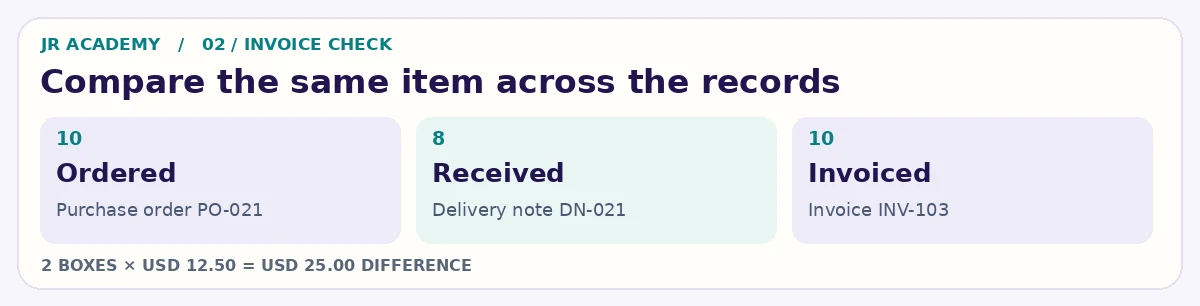
Set the order, receipt and invoice side by side. Two boxes appear on the invoice without a matching receipt, a difference of USD 25.00 at the stated unit price. Write a short message using the document references and ask whether the two remaining boxes will be delivered or the invoice will be revised. Put the question in the register so the response can be matched to the original business records.
Leave a handoff someone can act on
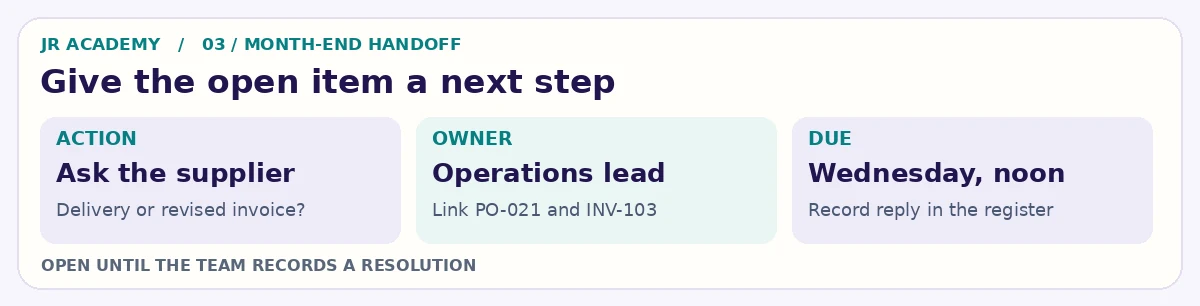
Record the item as open and assign the supplier follow-up to the operations lead. Add a deadline, such as Wednesday at noon, and link the business records the lead will need. If the reply confirms a second delivery, record who will check it. If the supplier issues a revision, link the new invoice to the order and mark what changed.
Test your handoff by asking someone to find the invoice, name the person responsible and explain what would resolve the issue. Give them only the register. If they have to ask you what to do, make the next action more specific. This quick check helps make the business records usable even when the original reviewer is away.
Use the workflow with your own business records
Apply the Business Records Essentials workflow to one routine purchase. Start with an order that has a delivery note and an invoice. Ask a colleague to find the three records and identify the next action using only the register. If they need to ask for another file or an owner, add the missing information before using the workflow more widely.
For background on how business records feed into accounting, read OpenStax’s guide to source documents and accounting information. You can also browse JR Academy courses or ask about training for your team.
Founders, operations staff and small-team administrators
Sign in to enrolAccess has no scheduled expiry.
What you will learn
- Organise the records for one order
- Check an invoice against the order and delivery
- Prepare a month-end handoff